Core Strategy
Countries cluster into predictable economic archetypes based on geography, resources, and development level:
- Oil States: Energy exports dwarf everything else (Saudi Arabia, Norway, Kuwait)
- Manufacturing Hubs: Diverse industrial exports, often import raw materials (Germany, Japan, South Korea)
- Resource Extractors: Dominated by one mineral/agricultural product (Chile copper, Ghana gold)
- City-States: Re-export economies, services heavy (Singapore, Hong Kong)
- Agricultural Powerhouses: Food exports match climate patterns (Brazil, Argentina, Australia)
Analysis Framework
Both exports and imports reveal patterns - oil states import manufactured goods, manufacturing hubs import raw materials, island nations import fuel and food. The import side often confirms your archetype guess.
Dead Giveaways (99% Confidence)
- Saudi Arabia: Oil 70%+, everything else tiny
- Australia: Iron ore + coal + gold dominant
- Singapore: Refined petroleum + electronics + chemicals (city-state)
- New Zealand: Dairy + meat + wool (isolated agriculture)
- Chile: Copper 40-60% dominance
- Norway: Oil + fish + aluminum (wealthy cold country)
Quick Elimination Rules
- >60% single commodity = resource extractor
- Diverse manufacturing = developed economy
- Refined petroleum prominent = either oil producer or processing hub
- Agricultural dominance = check climate zone for crop type
- Trade volume + pattern = immediate country tier elimination
Key Insights
- Systematic pattern recognition + geographic logic + spaced repetition through daily play = steady improvement
- Resource + processing combinations often beat pure expertise in specialized categories
- Trade volume constraints immediately eliminate impossible options
- Geographic distance clues help narrow regional possibilities
- Daily practice with real puzzles teaches country-specific signatures that pure theory misses
Fundamentals
- 10 teams, 20 drivers, ~24 races per year
- Points: 25 for win, 18 for 2nd, 15 for 3rd, down to 1 point for 10th
- Fastest lap gets 1 bonus point (if you finish top 10)
- Race weekend
- Friday: practice sessions (car setup)
- Saturday: qualifying (determines starting positions)
- Q1: all 20 cars, slowest 5 eliminated
- Q2: remaining 15 cars, slowest 5 eliminated
- Q3: final 10 cars fight for pole (1st place)
- Sunday: race (~300km or 2 hours max)
- Hot lap: single fast lap at maximum speed for qualifying or practice times
- Formation lap: prior to official start
- FP: free practice
- Flags
- Black: immediate disqualification
- Red: immediate danger
- White: slow-moving vehicle on the track e.g. emergency vehicle
- Checkered: race start and end
- Yellow: caution advised
Race Strategy
- Must use 2 different tire compounds during race
- Soft tires: fast, high grip, fast degradation
- Medium tires: balanced
- Hard tires: low grip, durable
- Pit stops: change tires, refuel (takes 2-3 seconds)
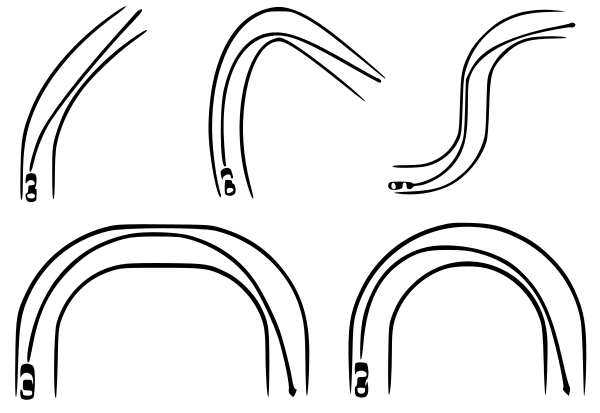
- Increasing/decreasing radius (from left to right, top to bottom: increasing radius, decreasing radius, chicane, double apex, hair pin)
- Fuel conservation
- DRS (Drag Reduction System): temporary opening of rear wing up to 85mm, reducing the downforce and aerodynamic drag of car, increasing top speed up to 15 km/hr; usable only in DRS zones — usually a straight stretch; purpose is to overtake — the driver must be within a second of predecessor, may not be used within the first two laps or when raining; before the corner, the wing closes so drivers have downforce for braking zones and corners.
- Undercutting: pitting before the car(s) in front to try and gain a position, often used at tracks where overtaking is more difficult
- Overcutting: staying on the track longer than immediate rival to gain a position; increases their pace compared to a rival who has pitted and advantage if rival who's pitted cannot quickly generate tyre temperature and is slower on their out-lap
- DRS train: cars locked in a stalemate, all in DRS range but unable to progress.
Circuit Features
- Hot track
- Pit lane: used for maintenance of vehicles, driver changes, and other necessary actions
- Curbs
- Scraping: painted white and green, sits outside standard curbs
- Sausage: raised; longitudinal (at the exit of corners), vertices (placed inside corners), and transverse (in corner exits and chicanes)
- Debris fences
- Cold track: when the track/pit is not being used by any vehicles
- Run-off: several types of runoffs, such as grass, gravel, sand or even an added section of tarmac
- Gravel trap
- Carpets: artificial grass
- Turns
- Chicane: serpentine (tight S- or Z-) curved road
- Corkscrew: chicane with drop in elevation
- Hairpins: 180° turns
- Carousel: a circular shaped turn
- Double apex: a corner/turn that is actually two turns
- Straightaway: straight section
- Speed trap: point where top speed of the car is measured using radar
- Crest: elevation peak where road transitions from uphill to downhill
- Braking zone: track section where drivers decelerate from straight-line speed to corner entry
- Parc fermé: closed park
- Paddock: restricted area behind the pit lane and garages where teams base their operations
Components of a Racecar
- Chassis / monocoque: shell onto which everything is bolted, composite (like spun carbon fibers set in resin or carbon fiber layered over aluminium mesh)
- Engine: 2.4L V8 engines producing nearly 900hp to be rebuilt after 500 miles because they run at nearly 19,000rpm; fuel powering it uses about 50 different fuel blends tuned for different tracks or conditions
- Pitot tubes: measures the speed of wind flowing over the top of the car.
- Transmission: transfers all of the engine's power to the rear wheels, bolted directly onto the back of the engine, includes gearbox, differential, and driveshaft:
- The gearbox must have a minimum of four forward gears and maximum of seven gears (total number includes forward, reverse, and neutral).
- The gearbox is connected to the differential, gears allowing the rear wheels to revolve at different speeds during cornering.
- The differential is connected to the driveshaft, a cylindrical shaft that powers the wheels. F1 drivers shift gears using the paddles behind the wheel.
- Aerodynamics
- Bargeboard are vertical planes and serve an aerodynamic rather than structural function, also acting as vortex generators.
- Wings create downforce (as opposed to aircraft wings, which produce lift) to hold the car onto the track, especially during cornering.
- Engineers in the 1970s discovered the car itself could be a giant one with an undercarriage design creating an area of low pressure that sucks the entire vehicle downward (the "ground-effect")—today the bottom of the cars must be flat from the nose cone to the rear axle line. Most cars have a diffuser, an upward-sweeping device between the engine and gearbox that creates a suction effect as it funnels air up and passes it to the rear of the car.
- Endplates are small, flanged (has a projecting rim)
Notable
Teams (2025)
| Team (car livery) | Drivers (helmet) | Information |
|---|---|---|
| McLaren (papaya, black) | Piastri (red/yellow/blue with black top, Australian flag elements) | Australian, prodigy, rapid development curve, remarkable composure |
| Norris (neon green psychedelic design with "LN" logo) | Established contender | |
| Mercedes (black, silver base with teal Petronas accents) | Russell (ice blue and black with #63) | Hot, knowledgeable, articulate |
| Antonelli (Italian flag, blue) | Prodigy | |
| Ferrari (darker red with white stripes) | Leclerc (red white) | Monaco royalty, son of F1 driver, strong qualifying history; "if you're talking about a driver who can consistently wring the neck of a car regardless of its limitations and successfully live on the edge in a livewire qualifying lap then you need to look no further than [Leclerc]" |
| Hamilton (Modena yellow) | Champion, social justice advocate | |
| RedBull (navy, red, yellow) | Max Verstappen (red, white, blue Dutch colours, lion on top) | Winners, best aerodynamics, technical excellence, aggressive, son of former F1 driver |
| Williams (Atlassian blue) | Sainz (red, yellow, blue) | So hot |
| Albon (pink, purple) | Thai-British | |
| Haas (white base, black, red) | Bearman (blue, yellow) | Prodigy |
| Ocon (black, red) | Humble roots | |
| Racing Bulls (predominantly white, VISA) | Hadjar (purple, chartreuse) | Prodigy, Franco-Algerian heritage |
| Lawson (white pink) | New Zealander | |
| Aston Martin (British green with black) | Alonso (dark and light blue, chartreuse) | Aging maestro, strategist |
| Stroll (dark teal) | Son of the owner of the team (nepotism) | |
| Kick Sauber (black base, green, Stake) | Bortoleto (white, green, yellow) | Carries Senna's legacy |
| Alpine (blue and pink, BWT) | Colapinto (white and blue Argentinia flag, pink) |
Statistics
- Finding patterns in uncertainty
- The central limit theorem emerges from calculus (as sample size approaches infinity, distributions converge to predictable shapes)
- Everything measurable varies (e.g. temperature, stock prices)
Calculus
Tracking continuous infinitesimal change (and rates of change?) to find totals (integrals) or instantaneous rates (derivatives)
- Function: Consistent rule mapping inputs to outputs
- Given f(x) = 3x - 5, calculate f(2) = 3(2) - 5 = 1
- The function value at x = 2 is 1. f(2) = 1.
- Derivative: Instantaneous rate of change
- Integrals: Area under curves, accumulation
Linear Algebra
Mapping transformations between spaces